QuantCoach’s Eye is resurrecting staple of the sports page
Do you know how I knew a local team or player was BIG TIME in Cincinnati in the 1970s and 1980s?
A championship trophy or a most valuable player award was not enough. Nor was a batting title or a perfectly bowled 300 or a victory in a local tennis or golf tournament.
Total supremacy and/or superiority was not recognized until you received a hat tip in the Sunday Cincinnati Enquirer from a local pizza magnate in the “Buddy LaRosa Sports” cartoon panel drawn by Hank Zureick.
Zureick played on Roger Bacon High School’s 1935 state champion baseball team. For 16 years he served as the Cincinnati Reds’ publicity director. In 1967, new general manager Bob Howsam fired him. Zureick became the bailiff in the visiting judge’s courtroom in the Hamilton County Courthouse. LaRosa (Roger Bacon Class of 1948), who also managed boxing champion Aaron “the Hawk” Pryor, tasked Zureick with establishing a sports hall of fame to honor local achievement and promote his chain of “LaRosa’s Pizzeria” franchises.
On the front page of the January 6, 1986, sports section, the Enquirer reported Dan Marino rallied the Miami Dolphins over the Cleveland Browns in the AFC Playoffs and the Los Angeles Rams’ Eric Dickerson ran roughshod over the Dallas Cowboys in the NFC Playoffs. Also, Major League Baseball Commissioner Peter Ueberroth wanted to talk to Cincinnati Reds’ outfielder Dave Parker about his testimony in a cocaine trial in Pittsburgh.
On page B-12, my high school football team, the Archbishop Moeller Crusaders, fresh off a 35-11 state championship victory a month earlier over Canton McKinley High school, received the coveted “Buddy’s ‘Hat’s Off’ …… TO MOELLER FOOTBALL” recognition. Zureick’s cartoon featured head coach Steve Klonne (“Steve teaches consumer economics and typing.”) and captain Ray Hilvert (“Klonne says ‘Ray is the most intense competitor we have ever had.’”).
The path to Zureick’s recognition was not a smooth one. In the regional finals, we faced undefeated Princeton High School. The Vikings were our archrival. We met every year with a trip to “state” always hanging in the balance.
Jerry Dowling was another Enquirer sports cartoonist. His “Pen-Pourri” cartoon was a regular part of the paper. On November 16, 1985, the front page of the sports section featured Dowling’s drawing of Klonne in full knight’s armor and Mancuso in viking battle attire with swords and shields crossed. “Again?” Mancuso inquired. “Again!” Klonne responded. “Surely they joust!” Dowling’s signature rat observed in the bottom left-hand corner of the cartoon. It was a masterpiece.
Zureick and Dowling were just two of the many sports cartoonists on newsroom staffs in the 20th Century.
To the best of my knowledge, the Boston Globe published the first sports cartoon on June 3, 1876. Six weeks after Boston met Philadelphia in the first baseball game in National League history, superstar Albert Spalding and his Chicago nine came to Boston for a game. President Ulysses S. Grant was nearing the end of his second term. Federal troops still occupied Louisiana and South Carolina. The Globe’s cartoon reflected the times. If Boston positioned a cannon on first base, the newspaper suggested, Spalding could be “disposed of without any ‘errors’ or ‘assists.’”
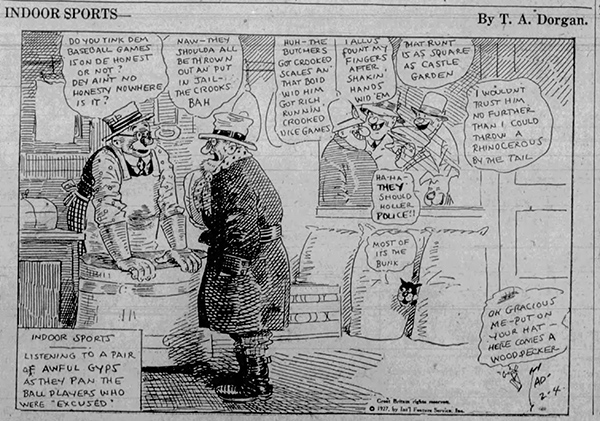
A year later, Thomas A. “Tad” Dorgan was born in San Francisco. In the early years of the 20th Century, he gained notoriety drawing boxing and baseball cartoons for several West Coast newspapers. After moving to New York, he created one of the first syndicated sports cartoons, “Indoor Sports,” in the New York Evening Journal. The cartoons, like the one above, treated everyday life as sport.
If a Neology Hall of Fame existed (neology is the use of a new word or expression or of an established word in a new or different sense), Dorgan would be a first-ballot inductee. “Apple sauce,” “skiddo,” “bunk,” and “hard-boiled” are just some of the words he coined or popularized. The last he picked up from Jack Doyle, who made book in Times Square.
Dorgan had no problem with the bookmakers and occasionally joined in the newsroom dice game. The legendary Arthur Brisbane was Dorgan’s editor. Brisbane was a socialist. All socialists HATE gambling. They abhor the liquid phase of financial gain and loss. On one occasion, Brisbane walked into the newsroom as his men rolled the bones. Everyone, even the shooter, froze. Dorgan calmly told Brisbane, “There’s a quarter open, do you want it?” Dorgan and publisher William Randolph Hearst rubbed off on Brisbane, who switched sides and joined the capitalist team.
“Artistically, his drawing was not exactly ideal,” Chicago Tribune columnist Westbrook Pegler wrote upon Dorgan’s death, “but it was his analysis, done in the gruff humor of a fellow who dealt strictly in candor, that made him great.”
Other cartoonists had an affinity for some action and included it in their sports cartoons. At Collyer’s Eye, a sports cartoon by “Cash” or some other artist often adorned the front page, above the fold. The weekly covered sports (and the markets) from the capitalist’s perspective like no other publication did before or has since. In advertisements, Bert Collyer offered five dollars to readers for cartoon suggestions.
West Coach cartoonist Al Vermeer’s character Abdul “got his licks” picking college football games. In Victoria, Texas, E.I. “Sticks” Stahala made “Sticks Picks” in the Victoria Advocate of Southwest Conference games and bowl games (see below).
A decade after Dorgan passed away, Willard Mullin emerged as the nation’s sports cartoonist laureate when his “Brooklyn Bum” made his debut in the New York World-Telegram and The Sporting News. The “Bum” made Mullin a rockstar after Dodgers’ fans adopted him as their representative. Unlike Dorgan, Mullin’s artistry was magnificent. His signature looked like blades of grass. Mullin often attended games and sketched key poses in pencil. Later in his studio, working under intense deadline pressure, he produced a finished pen and ink product. As a result of his popularity, Mullin became a celebrity endorser. He pitched everything from headache powder to men’s shoes.
Bill Gallo was the last of the great New York sports cartoonists during the “Golden Age of Newspapers.” Unlike the self-taught Dorgan and Mullin, Gallo was educated in art at Columbia University and the Cartoonists and Illustrators School (now known as the School of Visual Arts). In 1960, he took over the sports cartoonist’s pen from Leo O’Melia at the New York Daily News.
Incredibly, almost as soon as he took the job, Gallo foresaw the demise of his profession. In the March 10, 1960, edition, Gallo drew a robot baseball writer to accompany Jimmy Powers’ column on a mechanical pitching machine called “Iron Mike” that was tearing up spring training. “Everything in baseball is mechanical nowadays,” the caption read. “BILL GALLO, sports cartoonist of THE NEWS, depicts what might happen if automation takes over the writing field.”
In hindsight, Gallo should have named his robot “Google” or “meme.” Search advertising mortally wounded the newspaper business model by siphoning off most of its classified advertising revenue. Memes, which can be almost instantly produced and infinitely reproduced at no additional marginal cost, emerged to provide social media surfers with “Crying Jordan,” “McKayla Maroney is not impressed,” and, most recently, “Turkish Olympic sharpshooter Yusuf Dikec.”
“Sports cartooning is an antiquated form of commentary that hinged on tried-and-true tricks that are considered passe and corny,” Bob Staake told the New York Times’ Richard Sandomir in 2012.
Perhaps, Staake is right. A vintage sports cartoon, such as Gallo’s obiturary of New York Yankees’ catcher Thurman Munson, occassionally pops up on my social media timelines. But it is rare.
Still, vintage goods have found niche markets in clothing, music, and other sectors. Can vintage sports cartoons and new sports cartoons find a market?
I have a sports cartoonist and I am not afraid to use him. His name is Andrew Paavola. He graduated from the Columbus College of Art and Design in 2001. I met him at the Upper Arlington Art Show in Columbus about 15 years ago. When I decided to write a book, I knew I wanted the cover to be a sports cartoon. If you bought a copy of Bookmakers vs Ball Owners: Behind the Demolition of the U.S. Ban on Honorable Sports Betting and Bookmaking, you have seen his work. Andrew will be the tip of my spear in my campaign to resurrect sports cartoons.
“A ray of sunshine across the old world has turned to shadow. A peal of joyous laughter has been suddenly hushed,” legendary columnist Damon Runyon wrote in his obiturary of Tad Dorgan. The same can now be said for the sports cartoon art.
If you would enjoy seeing those rays of sunshine and hearing those peals of joyous laughter again, I hope you will consider supporting this web site and subscribing to QuantCoach’s Eye: The Capitalist’s Sports Newsletter.
